 Ivorycom
Definition
What is an AI CRM?
Every CRM vendor now has an AI page, which makes the category name almost useless as a filter. A definition is only worth having if it can be applied in a thirty-minute demo, so this one is built out of things you can watch happen.
The short definition
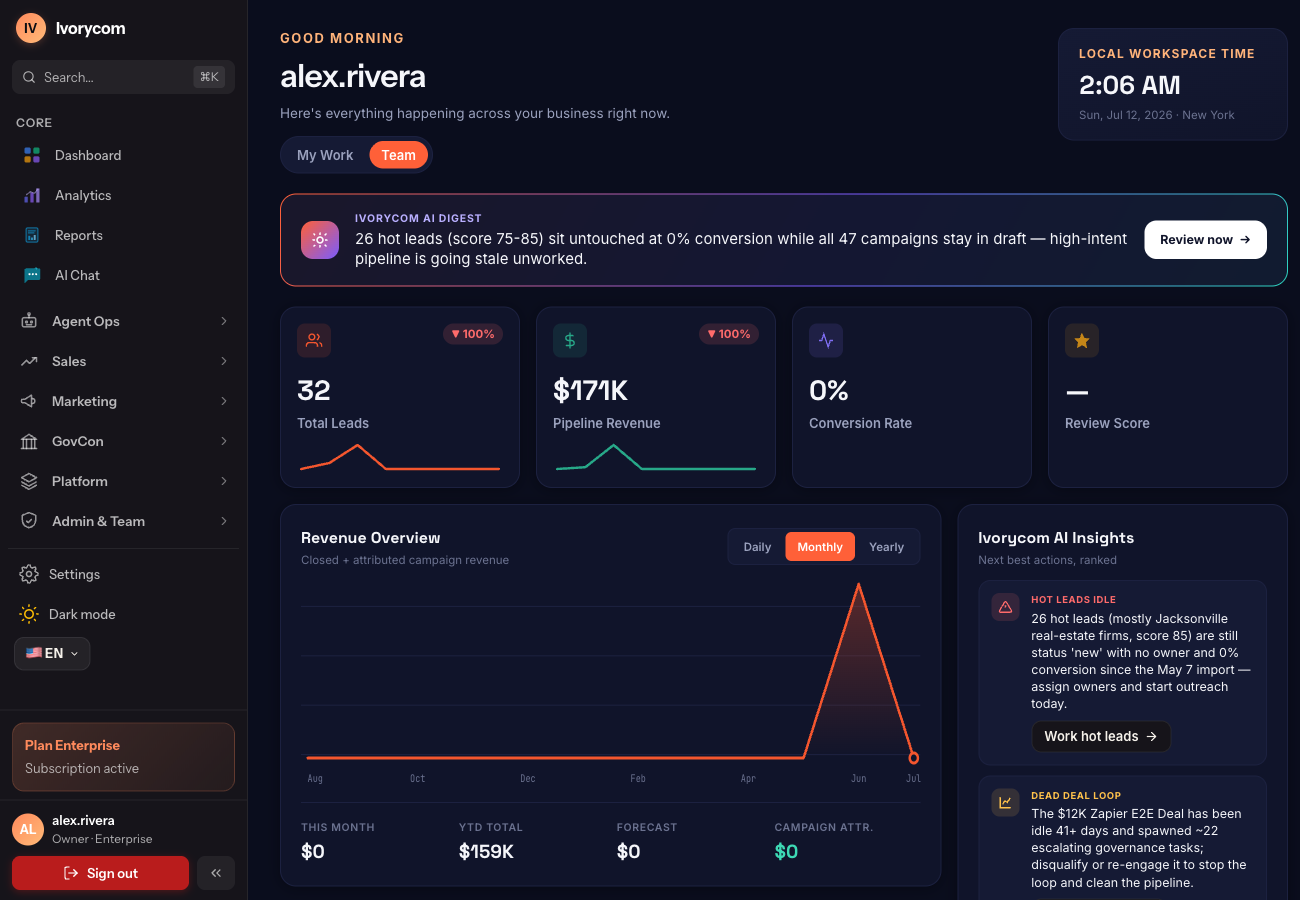
An AI CRM is a customer relationship management system in which software, not only people, reads the record and produces work from it. The data model is the same one every CRM has had for twenty years. What changes is that the record has a second reader — one that runs continuously, scores what it finds, and puts the result somewhere a person will act on it.
- A CRM stores what happened. An AI CRM also forms an opinion about what it means.
- The opinion has to arrive as work — a ranked list, a draft, a task — or nothing has actually changed.
- The system is still a system of record. Interpretation sits on top of the record; it does not replace it.
Why the category name stopped being a filter
Three quite different products currently ship under the same label, and the gap between them is larger than the gap between two traditional CRMs. Knowing which one you are being shown is most of the evaluation.
- A CRM with a chat panel. It answers questions about your data when you open it. Useful, but everything still starts with a person deciding to ask.
- A CRM with generative features. It drafts an email or summarizes a call on demand. The trigger is still a click.
- A CRM that interprets on write. A new event changes a score, a queue and an owner without anyone opening anything.
Test one: does anything happen when nobody is looking?
This is the fastest way to place a product in one of those three buckets, and it takes about two minutes. Ask the vendor to add an inbound reply to a record, then close the panel and stop touching the software. Come back to the record and see what is different.
- If the record has one more row and nothing else moved, you are looking at storage with an assistant attached.
- If a score changed, a task appeared, or the record moved queues, interpretation is running on write.
- Ask specifically what runs overnight with nobody signed in. The answer separates a feature from an operating model.
Test two: can it show you why?
A number with no reasoning behind it gets ignored within a couple of weeks of go-live, and an ignored score is worse than no score because it still occupies screen space and still implies the system knows something. The useful question is not how accurate the model is. It is whether a rep can read the justification and disagree with it out loud.
- Ask to see the evidence attached to a single score, on a single record, not a model accuracy claim.
- Ask what a rep does when they think the score is wrong, and whether that disagreement changes anything.
- Ask which fields the score is reading. If nobody can say, nobody will trust it.
Test three: what is it allowed to do on its own?
This is the question that decides whether an AI CRM is deployable in a real company, and it is usually the one demos skip. Interpretation is safe. Action is not, and the two get discussed as if they were the same capability. A system that can send on your behalf needs a different answer than one that can only rank.
- Reasoning is not authorization. A model concluding an action is correct is not the same as the action being permitted.
- Look for per-workflow limits, not a single global switch labeled something like AI autonomy.
- Ask what is logged. If an action is not recorded with what took it and why, it cannot be reviewed after the fact.
- Ask which actions require a person to confirm, and whether you can change that list yourself.
What an AI CRM does not fix
It is worth being blunt about the boundary, because most disappointment with this category comes from expecting the interpretation layer to compensate for a record nobody maintains. It cannot. Interpretation is a function of the data it reads, and a system reading three duplicate versions of one company will produce three confident, contradictory answers.
- Identity resolution comes first. Duplicates do not degrade scoring gently; they corrupt it.
- A thin record produces thin reasoning. If activity was never captured, no model recovers it.
- Judgment stays with people — whether to pursue an ambiguous account, what to concede, when to walk away.
- It will not tell you your pipeline is healthy when it is not. Expect the first month to be uncomfortable.
A sensible way to evaluate one
Bring your own data, keep the autonomy setting low, and grade the software against opinions you already hold. A demo on a vendor's seeded workspace proves the product runs. It tells you nothing about whether its judgment matches yours, which is the only thing you are actually buying.
- Import a few hundred real records where you already know the answer, so the output can be graded.
- Start at score-only. Autonomy is far easier to raise later than to walk back after an incident.
- Compare the ranking against your own for two weeks before turning anything on.
- Judge it on the work it prepares, not on the dashboard it draws.
The three products sold as AI CRM
Same category name, three different operating models. The right-hand column is the one that changes how a week actually runs.
| What you can check | CRM + chat panel | CRM + generative features | AI CRM that interprets on write |
|---|---|---|---|
| What starts the work | A person asks | A person clicks | A record changes |
| When it runs | While you watch | On demand | Continuously, including overnight |
| What you get back | An answer in a panel | A draft you asked for | A ranked queue and prepared work |
| Where reasoning lives | In the chat thread | Nowhere after you close it | Attached to the record |
| What governance it needs | Data access controls | Data access controls | Permissions, approval and an audit trail |
| What breaks it | Nothing — it is optional | Nothing — it is optional | A dirty record, immediately and visibly |
Frequently asked questions
Is an AI CRM different from a CRM with AI features?
In practice, yes, and the difference is the trigger. AI features wait to be invoked; an AI CRM interprets the record as it changes and produces work without being asked. Both are legitimate products — they just do not replace the same amount of human effort.
Do we need clean data before we start?
Not as a prerequisite, but sequence it honestly. Deduplication and field mapping can run during import, and scoring is only as good as the record underneath it, so identity resolution is usually the first thing worth getting right whichever system you pick.
Will an AI CRM replace sales roles?
It replaces logistics, not relationships. Data entry, deduplication, routing, first-draft follow-ups and keeping a forecast in step with reality are mechanical and high-volume. Negotiating, qualifying an ambiguous account and holding a relationship are not, and automating them tends to produce worse outcomes rather than cheaper ones.
How is an AI CRM different from marketing automation?
Marketing automation executes a path somebody designed in advance: if this, then that. An AI CRM decides what the situation is before deciding what to do about it. The two coexist — most teams keep deterministic automation for compliance-sensitive paths and let interpretation handle prioritization.