 Ivorycom
Definition
What is a GovCon CRM?
A commercial CRM assumes you find a buyer, qualify them and negotiate. Federal contracting inverts almost every part of that: the requirement is published, the process is defined in regulation, and the decisive work happens months before anything is competed.
The definition
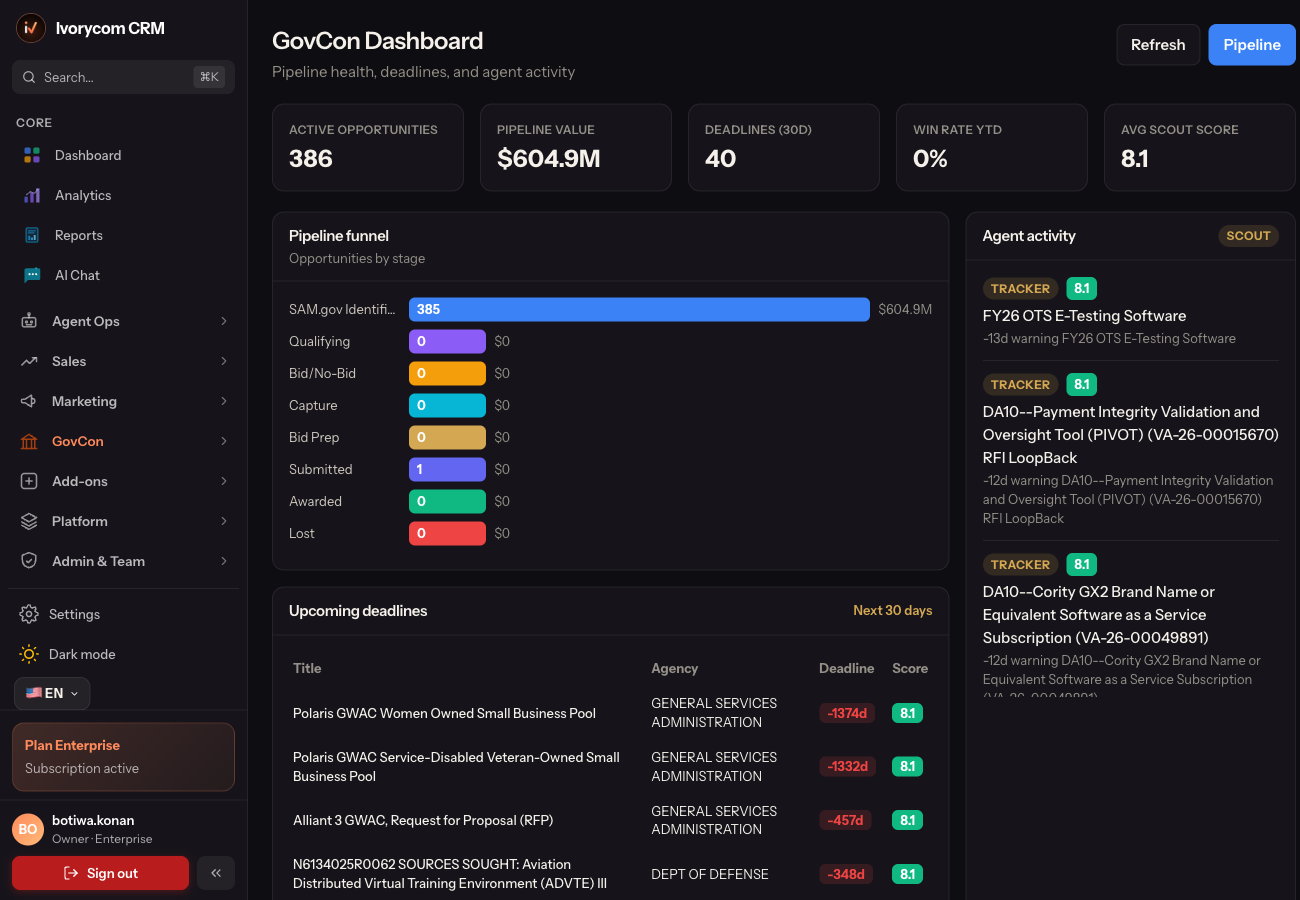
A GovCon CRM is a system built around the federal capture lifecycle rather than the commercial sales funnel. It tracks opportunities that exist independently of you, on timelines set by an agency, against qualification criteria that are largely published rather than discovered — and it treats the pre-solicitation period as the part where the work is actually done.
- The opportunity exists whether or not you found it. Sourcing is a monitoring problem, not a prospecting one.
- Qualification is against published criteria — set-asides, NAICS, size standards, past performance.
- The decisive activity happens before the solicitation is competed, not after.
Why a commercial pipeline does not fit
Teams routinely try to run capture in a standard CRM by renaming stages, and it half-works for a while. The mismatch is structural rather than cosmetic, and it shows up as a set of fields nobody maintains and dates that mean different things to different people.
- Deal value is a range or a ceiling, often across a multi-year vehicle, not a number.
- The close date is a submission deadline set by someone else, and it does not move because you want it to.
- Probability is not a stage percentage; it is a bid or no-bid judgment about a specific competition.
- The counterparty is an agency and a contracting officer with defined constraints, not a buyer you can persuade.
The four things it has to model
These are what distinguish a genuine GovCon system from a commercial CRM with renamed stages. Each of them exists because federal work has a constraint commercial work does not.
- Vehicles and set-asides. Eligibility is a gate that comes before qualification, and it is binary.
- Teaming. Prime and subcontractor relationships change per opportunity, so the same company is a partner and a competitor in different rows.
- Compliance artifacts. Capability statements, past performance, registrations and certifications are pursuit inputs, not marketing collateral.
- Agency relationships, which persist across opportunities and outlive any single pursuit.
Where the pipeline actually leaks
Not in negotiation, which barely exists in the commercial sense. It leaks at sourcing and at the bid decision, and both are volume problems that a small team cannot solve by working harder.
- Sourcing: relevant opportunities are published and missed, because nobody has time to read everything daily.
- Bid decision: pursuing a competition you were never positioned to win consumes weeks that had an alternative use.
- Deadlines: a submission window closes on a pursuit that was already qualified and worked.
- Institutional memory: the reason a past bid failed lives with a person, not on a record.
Where AI genuinely helps here
Federal capture is unusually well suited to automation for a specific reason: much of the input is public, structured and published on a schedule. That is rare, and it is why the sourcing and screening problem is more tractable in GovCon than in commercial sales.
- Continuous sourcing against your codes, so nothing relevant is missed because it was a busy week.
- First-pass fit scoring against your capability statement and past performance, which is a reading task.
- Deadline tracking with lead time, so a submission window never closes unnoticed.
- Drafting and assembly of recurring response components, leaving the judgment to a person.
What must stay with a person
The bid decision, and everything downstream of it. This is not caution — it is that the inputs to a good bid decision are largely not in any system: relationships, incumbent knowledge, what your team can actually deliver in the window, and what else you would do with those weeks.
- Bid or no-bid. A score narrows the list; it does not make the call.
- Teaming decisions, which are relationship judgments with long consequences.
- Anything submitted to the government. Accuracy obligations attach to the submitter.
- Pricing strategy, which depends on information that is deliberately not written down.
How to evaluate one
Most evaluations focus on whether the system connects to public opportunity data. It probably does, and so does everything else in the category — so that question does not separate anything. The differentiators are downstream of sourcing.
- Ask how fit is scored, and whether the reasoning cites your capability statement specifically.
- Ask what happens to an opportunity you decide not to bid — is the reason captured for next time?
- Ask how teaming is represented when one company is both partner and competitor.
- Ask what the deadline behavior is: a date field, or lead-time alerting with escalation.
Commercial CRM and GovCon CRM, on the same objects
The fields have similar names and mean different things, which is why renaming stages does not work.
| Object | Commercial CRM | GovCon CRM |
|---|---|---|
| The opportunity | Created when you find a buyer | Exists independently; published on a schedule |
| Qualification | Discovered through conversation | Largely published — set-aside, NAICS, size standard |
| Value | A negotiated number | A ceiling or range, often multi-year |
| Close date | Forecast, and it moves | A submission deadline, and it does not |
| Probability | A stage percentage | A bid or no-bid judgment about one competition |
| The counterparty | A buyer you can persuade | An agency and a contracting officer with constraints |
| Competitors | Sometimes known | Often known, and sometimes also your teaming partner |
| Where work concentrates | After qualification | Before the solicitation is competed |
Frequently asked questions
Can we just use a commercial CRM with custom fields?
For a handful of pursuits a year, yes, and plenty of firms do. It degrades as volume grows because the mismatch is structural: value is a ceiling not a number, the close date is not yours to move, and probability is a bid decision rather than a stage percentage. What you notice first is a set of custom fields nobody maintains.
What is capture management, and is it the same thing?
Capture management is the discipline of positioning for a specific opportunity before it is competed — shaping requirements, building relationships, assembling a team. A GovCon CRM is the system that supports it. The distinction matters because a system that only tracks solicitations after they publish is missing the period where the outcome is largely decided.
How does an AI-assisted GovCon system source opportunities?
In Ivorycom's case, agents source daily from SAM.gov against your NAICS codes, then score fit against your capability statement, with separate agents handling response preparation and deadline tracking. The sourcing half is the easier problem because the data is public and structured; the scoring half is where systems differ.
Does this replace a proposal management tool?
No. A GovCon CRM covers sourcing, qualification, capture and the bid decision. Proposal development — volumes, compliance matrices, reviews — is a separate discipline with its own tooling, and the useful integration point is that the CRM should carry the decision and the context into whatever produces the response.